
Data lineage tracking creates a living, auditable map of where data came from, how it changed, and who consumes it. The recommended enterprise approach: automate table-level lineage broadly across your pipelines first, then layer in column-level tracking for regulated, high-risk, or ML-critical assets, using OpenLineage-compatible instrumentation wherever possible. That sequence gives you fast root-cause analysis and impact analysis from day one, with the granularity compliance and governance teams actually need added incrementally.
Three immediate benefits drive most enterprise investments:
- Faster root-cause analysis: when a dashboard breaks, lineage tells you which upstream job or source table changed, cutting mean time to resolution from hours to minutes.
- Impact analysis before changes ship: you can see every downstream consumer of a column before you rename or drop it.
- Auditability: regulators and auditors get a timestamped, reproducible trail of every transformation a data asset passed through.
Table of Contents
- What does data lineage tracking actually capture?
- Design-time vs. runtime lineage, and which granularity you actually need
- How automated lineage capture works in practice
- Which tools and platforms should you use?
- How to roll out lineage in phases
- Tracing a broken dashboard metric back to its source
- Common challenges and how to handle them
- How lineage supports data governance, MDM, and ML governance
- What a practical rollout actually looks like
- Key Takeaways
- The gap most lineage programs fall into
- Aliakhtari can instrument your lineage pipeline
- Authoritative docs and specs to read next
What does data lineage tracking actually capture?
IBM frames lineage as an audit trail that documents sources, transformations, storage locations, and consumers. That framing is accurate but undersells the operational detail. A complete lineage record captures six things: the source (which system or file the data originated from), the transformation (the SQL, Spark job, or dbt model that changed it), the path (the sequence of datasets it passed through), the timestamp and version (when each run happened and which schema was active), the destination (which tables, reports, or APIs consume it), and ownership (who is responsible for each node).
Two terms often get conflated with lineage. Data provenance is narrower: it focuses on origin and custody, the chain-of-custody record for a single dataset. Data traceability is broader: it describes the general ability to follow data across systems, which may or may not be automated. Lineage sits between them. It is provenance made operational and queryable across an entire pipeline graph.
Manual diagrams decay the moment a pipeline changes. Automated lineage capture, by contrast, updates every time a job runs, which means the graph you query today reflects production reality rather than a six-month-old Confluence page.
Design-time vs. runtime lineage, and which granularity you actually need
Design-time vs. runtime
OpenLineage separates two event types: design-time events (JobEvent and DatasetEvent) and runtime events (RunEvent). Design-time events capture stable facts: schema definitions, ownership assignments, declared dependencies. Runtime events capture what actually executed: exact inputs, outputs, row counts, and timestamps per run.
Neither is sufficient alone. Design-time lineage is your documentation truth. Runtime lineage is your operational truth. When they diverge, that gap is itself a signal worth investigating.
Granularity options
| Granularity | What it tracks | Primary use case | Priority |
|---|---|---|---|
| Table-level | Which tables read/written per job | Root-cause triage, migration planning | Start here — instrument everything |
| Column-level | Which source columns feed which output columns | Compliance, PII detection, ML feature provenance | Add for regulated and critical assets |
| Report/dashboard-level | Which datasets feed which BI reports | Impact analysis for BI consumers | Add when BI breakage is a recurring pain |
| End-to-end / cross-system | Full path from source system to final consumer | Regulatory audit, data product certification | Add last; highest instrumentation cost |
The trade-off is straightforward: table-level lineage is cheap to capture and covers most debugging scenarios. Column-level lineage is more expensive to emit and store, but it is the only way to answer "which source field feeds the revenue figure in this report?" End-to-end lineage across system boundaries requires cross-platform reconciliation and is the most expensive to maintain.
Pro Tip: Start with automated table-level lineage everywhere, then prioritize column-level instrumentation on assets that touch regulated data (HIPAA, SOX, CCPA), financial calculations, or ML training features. Instrument those first and backfill the rest later.
How automated lineage capture works in practice
Google Cloud describes three core capture techniques: parsing, monitoring, and API-driven capture. In practice, most enterprise implementations combine all three.
Query parsing extracts lineage from SQL statements, dbt models, or Spark plans at compile or execution time. The parser reads the query's input and output references and constructs a lineage edge. This works well for SQL-heavy environments and is the foundation of most catalog integrations.
Log-based extraction reads query logs or execution logs after the fact. It is non-invasive but introduces latency and can miss dynamic SQL patterns.
Pipeline-native instrumentation embeds lineage emission directly into the job. The OpenLineage GitHub project provides integrations for Airflow, dbt, Spark, and Flink that emit RunEvents automatically when a job starts and completes. This is the most reliable capture method for modern pipelines.
API-driven capture uses a lineage API (such as Google Cloud's Data Lineage API or a catalog's REST endpoint) to write lineage records programmatically. Useful for custom jobs or legacy systems where native instrumentation is not available.
The OpenLineage event model
The OpenLineage spec defines three core objects: Run, Job, and Dataset. A RunEvent ties them together: it records that a specific Job run consumed specific input Datasets and produced specific output Datasets.
Facets enrich these objects with structured metadata:
| Facet | Attached to | What it adds |
|---|---|---|
schema | Dataset | Column names, types, and nullable flags |
columnLineage | Dataset | Input-to-output column mappings |
dataQuality | Dataset | Row counts, null counts, distinct counts |
ownership | Job or Dataset | Responsible team or individual |
lifecycleStateChange | Dataset | Create, overwrite, drop, truncate events |
version | Dataset | Schema version at time of run |
Facets are additive: a later RunEvent can add or replace a named facet without invalidating earlier events. That means you can attach quality metrics to a lineage node after the fact, which is useful when quality checks run asynchronously.
A minimal OpenLineage RunEvent in Python looks roughly like this:
from openlineage.client import OpenLineageClient
from openlineage.client.run import RunEvent, RunState, Run, Job, Dataset
from openlineage.client.utils import redact_with_exclusions
import uuid, datetime

client = OpenLineageClient.from_environment()

run_id = str(uuid.uuid4())
event = RunEvent(
    eventType=RunState.COMPLETE,
    eventTime=datetime.datetime.utcnow().isoformat() + "Z",
    run=Run(runId=run_id),
    job=Job(namespace="finance", name="revenue_transform"),
    inputs=[Dataset(namespace="warehouse", name="raw_transactions")],
    outputs=[Dataset(namespace="warehouse", name="daily_revenue")],
)
client.emit(event)
The capture pipeline then flows: emit events → ingest into a backend or catalog → normalize and reconcile design-time and runtime records → visualize and query in a lineage graph UI.
Which tools and platforms should you use?
The ecosystem splits into four roles: open standards, cloud-native catalogs, standalone metadata platforms, and vendor-managed lineage inside lakehouse platforms.
OpenLineage (the standard)
OpenLineage is not a product. It is an open specification and integration library that lets any tool emit and consume lineage events in a common format. If you instrument your Airflow DAGs and your dbt project with OpenLineage providers, both emit events that any OpenLineage-compatible backend can ingest. That portability is the main reason to build on it rather than a proprietary format.
The apache-airflow-providers-openlineage package wires Airflow task runs to RunEvents automatically. The dbt-ol integration does the same for dbt model runs. Spark and Flink have native OpenLineage integrations in the project.
Databricks Unity Catalog
Databricks documents that Unity Catalog captures column-level lineage automatically for notebooks, jobs, and SQL queries running on Databricks. No instrumentation code required. The lineage is queryable via the Unity Catalog UI and API. For teams already on Databricks, this is the lowest-friction path to column-level lineage on lakehouse assets.
The limitation: Unity Catalog lineage is scoped to Databricks. Cross-platform lineage (from an upstream Airflow job or a downstream Tableau report) still requires OpenLineage or a catalog integration.
Google Cloud BigQuery and Knowledge Catalog
Google Cloud's Data Lineage API captures lineage for BigQuery jobs automatically when enabled. Knowledge Catalog surfaces that lineage alongside other metadata. The apache-airflow-providers-openlineage package integrates Airflow with the Data Lineage API, so Airflow-orchestrated BigQuery jobs emit lineage without custom code. Like Unity Catalog, this is cloud-scoped unless you bridge it with an external catalog.
Atlan
Atlan's approach is to sit above the execution layer and aggregate lineage from multiple sources: SQL parsing, log-based tracking, pipeline-native lineage events, and API crawling. It supports table-level and column-level lineage across Snowflake, BigQuery, dbt, Airflow, and other connectors. The governance layer lets you attach ownership, certifications, and policies directly to lineage nodes. For organizations that need cross-platform lineage in a single UI, Atlan is a strong option.
IBM lineage tooling
IBM's data governance portfolio includes lineage capabilities that frame the audit trail as a compliance and governance artifact. IBM's framing is particularly relevant for regulated industries where lineage must satisfy external auditors rather than just internal engineers.
Pro Tip: If your environment spans more than one cloud or includes on-premises systems, invest in OpenLineage-compatible instrumentation from the start. Migrating from a proprietary lineage format later is painful.
How to roll out lineage in phases
The phased approach that Atlan recommends and most practitioners follow: pilot with a high-value business domain, automate table-level lineage, then expand to column-level for regulated and high-risk assets.
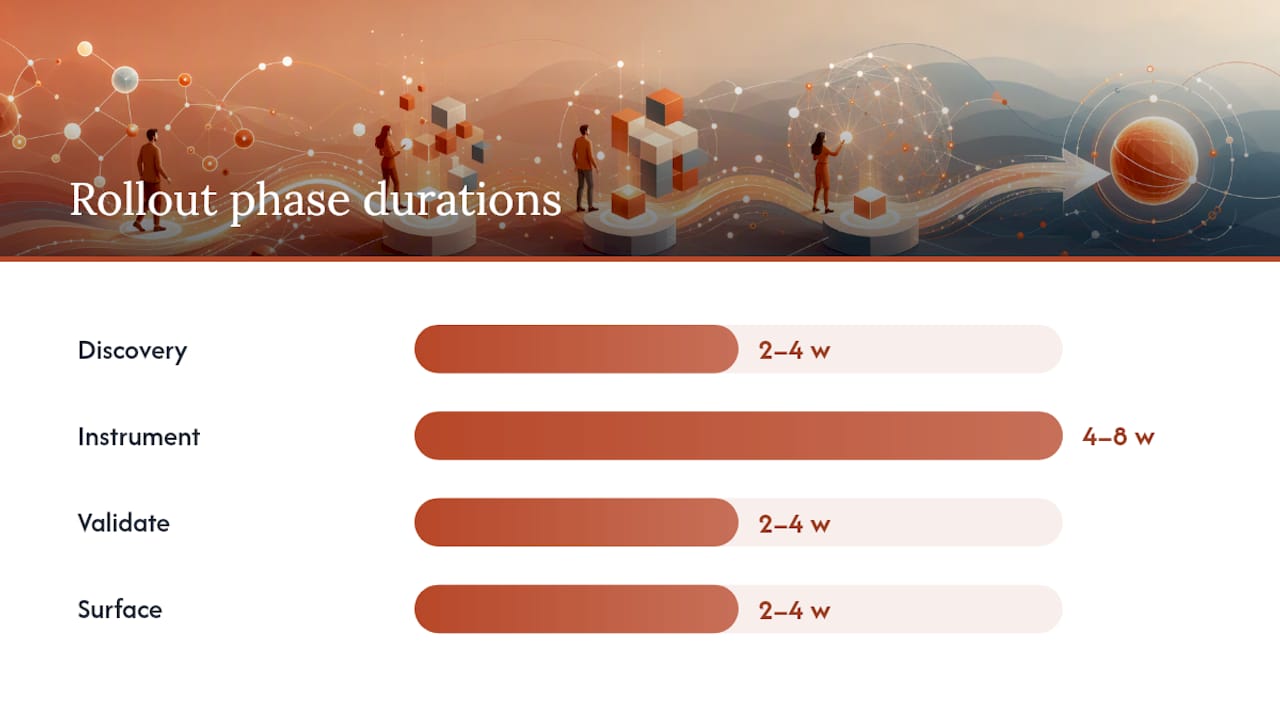
| Phase | Typical duration | Key activities | Success criteria |
|---|---|---|---|
| Discovery | 2–4 weeks | Inventory pipelines, identify Tier 1 assets, select pilot domain | Documented asset inventory with owners assigned |
| Instrument | 4–8 weeks | Deploy OpenLineage integrations, enable cloud-native lineage APIs, instrument pilot pipelines | Table-level lineage emitting for all pilot pipelines |
| Validate | 2–4 weeks | Business-owner review, reconcile design-time vs. runtime, fix gaps | Validation sign-off from at least two business owners |
| Surface | 2–4 weeks | Connect lineage to catalog UI, build impact-analysis workflow, train users | Analysts using lineage for at least one incident investigation |
| Operate | Ongoing | Monitor coverage, handle schema drift, expand to new domains | Coverage metric tracked monthly; column-level added for regulated assets |
Cost factors to plan for:
- Tool licensing: open-source OpenLineage integrations are free; managed catalog platforms (Atlan, cloud-native options) carry subscription costs.
- Engineering hours: instrumentation of a mid-size Airflow environment typically takes two to four weeks of a senior engineer's time.
- Storage and processing: lineage event volumes scale with job frequency. High-frequency streaming pipelines generate significant event volume.
- Validation and QA: business-owner review is often underestimated. Budget one to two hours per domain owner per validation cycle.
- Governance and training: data stewards need training on reading lineage graphs and acting on them.
Pro Tip: Scope your pilot to a single business domain with a known pain point (a recurring broken report, an upcoming compliance audit). A focused pilot produces a concrete ROI story that funds the broader rollout.
Tracing a broken dashboard metric back to its source
This is what lineage tracking looks like in practice. The goal: find why the weekly_active_users metric in a Tableau dashboard dropped 40% overnight.
- OpenLineage documentation
- OpenLineage object model (spec)
- OpenLineage / OpenLineage (GitHub)
- OpenLineage specification (Markdown)
- What is data lineage? | Google Cloud
- What Is Data Lineage? | IBM
- Data Lineage Tracking: Complete Guide for 2026
- What Is Data Lineage? | Databricks
- OpenMetadata column lineage guide
Total trace: five steps, all navigable in a lineage UI without writing a single query.
[Tableau Dashboard]
       ↑
[reporting.user_activity_weekly]  ← dbt model (RunEvent: row count 340K ⚠)
       ↑
[warehouse.session_events]  ← Spark job (lifecycleStateChange: OVERWRITE, 11:47 PM)
       ↑
[raw event stream / Kafka topic]
When lineage is incomplete, for example the Spark job has no RunEvent because it predates instrumentation, the mitigation is: check query logs for the job's execution time, manually document the gap as a lineage annotation, and add instrumentation to that job in the next sprint.
Pro Tip: Build a standard incident-response runbook step that says "check lineage graph first." Teams that do this consistently report the fastest mean-time-to-root-cause improvements.
Common challenges and how to handle them
Organizational challenges
| Challenge | Root cause | Mitigation |
|---|---|---|
| Ownership ambiguity | No one assigned to lineage nodes | Assign ownership during the Validate phase; block certification without an owner |
| Lack of incentives | Engineers see lineage as overhead | Tie lineage coverage to on-call runbooks; make it the default first step in incident response |
| Data consumer distrust | Lineage graph shows gaps or errors | Publish a coverage dashboard; be transparent about what is and is not instrumented |
| Operationalizing lineage | Lineage exists but no one uses it | Embed lineage links in Slack alerts, Jira tickets, and BI tool descriptions |
Red flags that signal early trouble:
- No owner assigned to more than 30% of Tier 1 assets after the Validate phase.
- Runtime events and design-time declarations diverge on more than 20% of critical pipelines.
- Lineage graph has not been queried in the past 30 days despite active incidents.
Pro Tip: The organizational challenges kill more lineage programs than the technical ones. Assign a named lineage program owner before you write a single line of instrumentation code.
How lineage supports data governance, MDM, and ML governance
Lineage provides the provenance and impact maps that governance programs need to function. Without lineage, master data management (MDM) policies are enforced at the point of entry but invisible downstream. With lineage, a governance team can trace every place a master entity (a customer ID, a product code) flows and verify that transformations preserve its integrity.
Governance integration points lineage enables:
- Ownership assignment: lineage graphs surface which teams write and read each asset, making ownership assignment factual rather than political.
- Policy enforcement: sensitive-data tags (PII, PHI, financial) propagate downstream through lineage. If a source column is tagged as PII, every derived column inherits that tag automatically in tools that support lineage-based propagation.
- Certification and auditing workflows: auditors can follow a lineage trace from a regulatory report back to the source system and verify every transformation step.
- ML feature provenance: knowing which raw tables and transformations produced a training dataset is required for model cards, reproducibility, and debugging prediction drift.
- Data quality integration: quality assertions attached as lineage facets make it possible to certify a dataset only when upstream quality checks pass.
Governance checklist for lineage programs:
- Assign a named owner to every Tier 1 lineage node before go-live.
- Define a retention policy for lineage metadata (most organizations retain 12–24 months of RunEvents).
- Restrict write access to lineage metadata to authorized emitters; read access can be broad.
- Integrate lineage review into data stewardship workflows so stewards see lineage context when certifying assets.
- Document which lineage nodes are covered by automated capture and which require manual annotation.
| Point | Details |
|---|---|
| Lineage enables policy propagation | Sensitive-data tags on source columns flow automatically to derived columns through lineage graphs. |
| Ownership becomes factual | Lineage surfaces which teams write and read each asset, grounding ownership in observed behavior. |
| ML governance requires provenance | Model reproducibility and drift debugging both depend on knowing which source tables fed training data. |
| Retention policy matters | Most organizations retain 12–24 months of RunEvents; define this before the event store grows unmanaged. |
What a practical rollout actually looks like
The single most effective pattern: start the pilot in a domain where a broken metric has already caused pain, wire OpenLineage instrumentation into the CI/CD pipeline on day one, and validate the first lineage graph with the business owner before expanding.
Implementation checklist for the first 90 days:
- Identify the pilot domain and its Tier 1 assets (the five to ten datasets that matter most to the business).
- Deploy OpenLineage integrations for the orchestration layer (Airflow, dbt, or Spark, whichever is dominant).
- Enable cloud-native lineage APIs where available (Unity Catalog automated lineage for Databricks workloads, Data Lineage API for BigQuery).
- Emit design-time DatasetEvents and JobEvents from the CI pipeline so impact analysis is available pre-deployment.
- Run a validation session with the domain's business owner. Document gaps and assign owners to unresolved nodes.
- Connect lineage to the catalog UI and add a lineage-check step to the incident-response runbook.
- Measure coverage percentage and mean time to root cause at the 30-day and 90-day marks.
Suggested KPIs:
- Lineage coverage on Tier 1 assets: target 100% at end of Instrument phase.
- Runtime vs. design-time reconciliation rate: target above 85% for instrumented pipelines.
- Mean time to root cause: track before and after lineage availability; a 50% reduction is a realistic 90-day target for teams with active incidents.
Pro Tip: Wire the OpenLineage emitter into your CI pipeline on the same day you deploy it to production. Design-time events from CI give you impact analysis before a change ships, which is where lineage pays off most visibly to engineering managers.
Key Takeaways
Automated, OpenLineage-compatible lineage capture, deployed in phases from table-level to column-level, is the most reliable path to fast root-cause analysis, compliant auditability, and trustworthy analytics in enterprise data environments.
| Point | Details |
|---|---|
| Start with table-level lineage | Automate table-level capture across all pipelines before adding column-level granularity. |
| Column-level for regulated assets | Prioritize column-level instrumentation on assets that touch compliance, financial calculations, or ML features. |
| OpenLineage for portability | Use OpenLineage-compatible instrumentation to avoid vendor lock-in across multi-cloud or hybrid environments. |
| Wire lineage into CI/CD | Emit design-time events from CI pipelines so impact analysis is available before changes ship to production. |
| Aliakhtari for custom instrumentation | Aliakhtari builds end-to-end lineage instrumentation, custom OpenLineage emitters, and pipeline automation for teams that need a faster path to production-grade lineage. |
The gap most lineage programs fall into
Most lineage programs fail at the same place: they treat lineage as a catalog feature rather than a pipeline engineering problem. Teams spend months configuring a catalog UI and almost no time on instrumentation. The result is a beautiful graph that reflects what someone documented six months ago, not what ran last night.
The programs that actually work treat lineage emission as a first-class engineering concern. Instrumentation goes into the pipeline code. RunEvents are emitted by the job, not scraped by a crawler. Design-time events are emitted by the CI pipeline, not entered manually into a catalog form. The catalog is just the query layer on top of a reliable event stream.
The second common failure is scope creep before the first phase is validated. Column-level lineage for every asset in the warehouse sounds thorough. In practice, it generates enormous event volume, slows down validation, and produces a graph so dense it is unusable. The phased approach, table-level everywhere first, column-level on the assets that genuinely need it, is not a compromise. It is the correct architecture.
One more thing practitioners underestimate: the organizational work is harder than the technical work. Getting a business owner to spend two hours validating a lineage graph is harder than deploying an Airflow provider. Getting an on-call engineer to check the lineage graph before querying tables manually requires a runbook change and a habit change. Neither happens automatically. Budget for it.
Aliakhtari can instrument your lineage pipeline
If your team has the data infrastructure but not the engineering bandwidth to wire up OpenLineage instrumentation, build custom emitters for legacy systems, or integrate lineage into your CI/CD pipeline, that is exactly the kind of engagement Aliakhtari takes on.
A typical engagement runs as a focused pilot: instrument the highest-priority domain, validate lineage with business owners, and deliver a working event pipeline with coverage metrics in place, usually within 60–90 days. The work covers OpenLineage provider deployment (Airflow, dbt, Spark), custom SDK development for systems that lack native integrations, CI/CD wiring for design-time events, and catalog connection. No long-term retainer required to get started. See current availability and active projects, or reach out directly to scope a pilot.
Authoritative docs and specs to read next
The resources below are the canonical references for implementers. Each covers a distinct layer of the stack.
- OpenLineage documentation — start here for the Run/Job/Dataset object model and facet definitions. The reference for anyone writing or consuming lineage events.
- OpenLineage object model spec — the design-time vs. runtime event distinction and how RunEvents, JobEvents, and DatasetEvents relate. Essential for understanding when to emit which event type.
- OpenLineage specification (Markdown) — the full spec including all dataset facets (schema, columnLineage, dataQuality, ownership, lifecycleStateChange). The ground truth for facet behavior and additive event rules.
- OpenLineage GitHub repository — integration code, provider packages, and implementation examples for Airflow, dbt, Spark, and Flink. The fastest path from spec to working instrumentation.
- Google Cloud: What is data lineage? — covers BigQuery and Knowledge Catalog lineage capture, the Data Lineage API, and the
apache-airflow-providers-openlineageintegration. Best for cloud-native GCP environments. - Databricks: What Is Data Lineage? — explains Unity Catalog automated column-level lineage and governance integration. Best for Databricks lakehouse environments.
- Atlan: Data Lineage Tracking Guide — practical phased rollout guidance, capture method comparison, and cross-platform catalog integration. Best for teams evaluating metadata platform options.
- IBM: What Is Data Lineage? — governance and compliance framing, audit trail concepts, and component overview. Best for regulated-industry teams building the business case.
- OpenMetadata column lineage guide — step-by-step guidance for capturing and integrating column-level lineage in an open-source metadata store. Best for teams using or evaluating OpenMetadata as their catalog backend.
Pro Tip: Read the OpenLineage object model spec before you write any instrumentation code. The design-time vs. runtime distinction shapes every architectural decision downstream.