
AI data provenance is the practice of recording, for every training record, the source URL or file hash, acquisition timestamp, license or terms-of-service version, contributor identity, consent flag, transformation history, and a cryptographic fingerprint (SHA-256) that ties the record to an immutable audit trail. Two actions matter most right now: add a record-level identifier at ingestion before any transformation touches the data, and generate an auditable manifest that covers every record in the training corpus before a model run begins. Get those two things right and you have the foundation for accountability, targeted unlearning, and defensible compliance evidence.
- Capture at ingestion. Assign a stable UUID and SHA-256 hash to every record the moment it enters your pipeline, before any cleaning or filtering step.
- Generate a pre-training manifest. Produce a signed, exportable file (JSON-LD or Parquet) that maps every record identifier to its license, source, and consent status.
- Tie provenance to outcomes. A complete provenance trail lets you respond to a data subject deletion request, answer a copyright audit, or reproduce a training run without guessing which records were included.
The urgency is real. Large-scale audits of more than 1,800 AI text datasets found license information missing in roughly 68–70% of cases and miscategorization error rates around 50%. Those numbers mean most teams building on popular open datasets are carrying legal and compliance risk they cannot currently quantify.
Table of Contents
- What "data provenance" actually means, and how it differs from lineage and documentation
- What empirical audits reveal about provenance gaps in popular AI datasets
- How to capture provenance: architectures, metadata strategies, and instrumentation
- Record-level provenance in practice: integration patterns and measured overhead
- Governance and legal considerations for U.S.-based AI teams
- Practical checklist: minimum viable provenance fields and how to operate them
- Common failure modes and how to mitigate them
- Key Takeaways
- A practitioner's view on realistic adoption paths
- Aliakhtari builds provenance-ready AI pipelines for teams that need audit trails
- Primary sources and further reading
What "data provenance" actually means, and how it differs from lineage and documentation
Precision on vocabulary matters here because "provenance," "lineage," and "documentation" are used interchangeably in the wild, but they describe different scopes of work.
Data provenance in AI refers to the origin and custody chain of individual training records: where a record came from, who contributed it, under what legal terms, when it was collected, what transformations were applied, and whether a cryptographic fingerprint confirms its integrity. Provenance operates at the record level (and, in the most granular implementations, at the token level).
Data lineage is broader and more operational. It tracks how data flows through a pipeline — which process read from which table, which job produced which output. Lineage is essential for debugging and pipeline governance, but it does not capture the legal or consent attributes of individual records. You can have perfect lineage and still have no idea whether a given record was licensed for commercial AI training.
Dataset documentation (Datasheets for Datasets, Data Cards, Data Provenance Cards) operates at the dataset level. A datasheet describes the collection methodology, intended use, and known limitations of a whole dataset. It is valuable for model cards and audit summaries, but it cannot support record-level unlearning or per-record compliance queries.
What empirical audits reveal about provenance gaps in popular AI datasets
The numbers from published audits are stark enough to change how you think about dataset selection. The MIT Data Provenance for AI project audited more than 1,800 datasets and built the Data Provenance Explorer, an interactive tool that lets practitioners trace licenses, sources, creators, and dataset composition across hundreds of widely used training corpora. The project also produces Data Provenance Cards — structured summaries of license status, collection methodology, and composition — for datasets in its coverage.
The large-scale audit findings that underpin this work are worth sitting with:
~68–70% of audited datasets had license information missing or unverifiable. ~50% showed miscategorization errors — meaning the license or source type recorded in the dataset's metadata did not match the actual terms of the underlying content.
| Audit metric | Finding |
|---|---|
| Datasets audited | 1,800+ |
| License omission rate | ~68–70% |
| Miscategorization / error rate | around 50% |
| Closed datasets with low-resource language content | Disproportionately high |
| Datasets with synthetic or generated content | Often undisclosed |
For model builders, these figures translate directly into risk. A miscategorization rate around 50% means that roughly half the license labels in a typical aggregated corpus are wrong. A team that relies on dataset-level metadata to assess its legal exposure is working from a coin-flip baseline. The academic survey on data provenance standards and auditing documents a related problem: when datasets are repackaged into dataset-of-datasets aggregations, original provenance metadata is frequently stripped or overwritten, compounding the error rate at each layer of composition.
The practical implication is that teams cannot trust inherited metadata. Provenance must be verified and re-recorded at the point of ingestion into your own pipeline, not assumed from the upstream source.
How to capture provenance: architectures, metadata strategies, and instrumentation
Three architectural patterns cover most production needs, and they are not mutually exclusive.
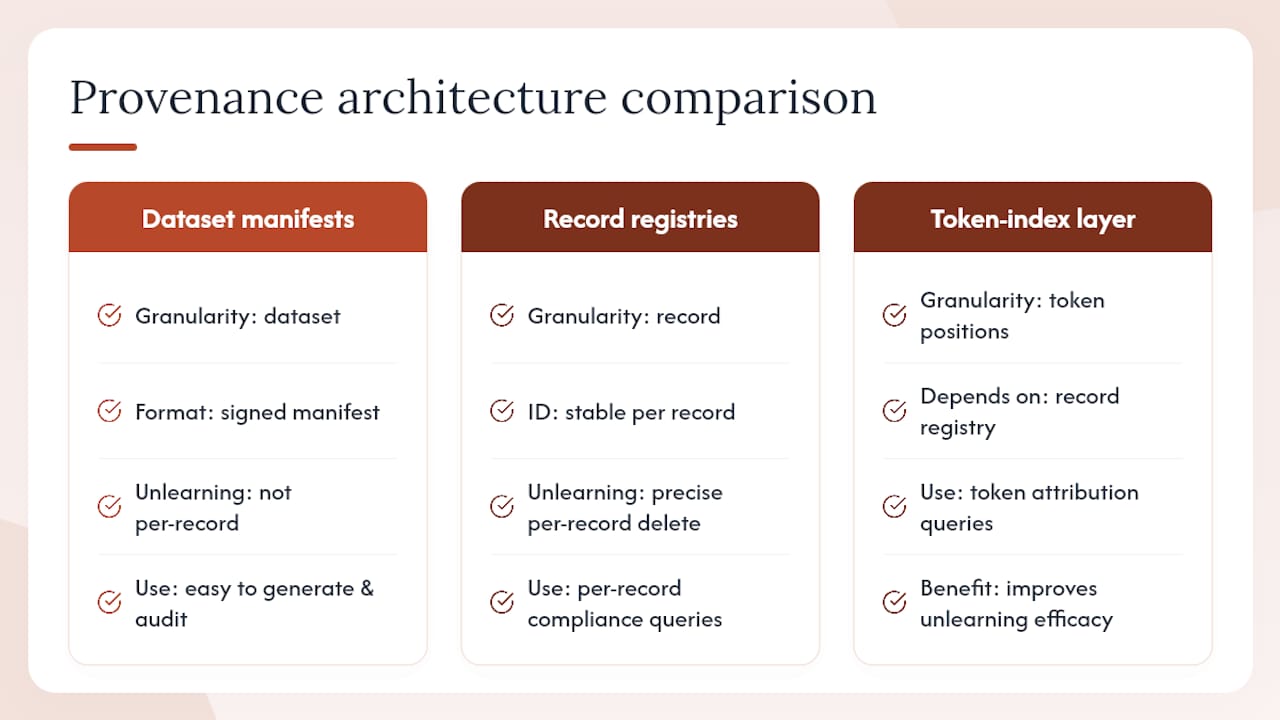
Dataset-level manifests are the lightest-weight option. A manifest is a signed file (JSON-LD, Parquet, or CSV) that lists every dataset in a training corpus with its license, source, version, and a hash of the dataset archive. Manifests are easy to generate and audit, but they cannot support record-level unlearning or per-record compliance queries.
Record-level registries assign a stable identifier and provenance metadata to every individual training record. The OriginBlame approach extends this to the token level, building an index that maps each token in a training corpus back to its source record. This granularity is what makes precise unlearning possible: instead of deleting an entire dataset when one record is disputed, you can identify and remove exactly the affected records and their token contributions.
Token-index layer approaches sit on top of record-level registries and are most relevant for large language model training. The index maps token positions in packed training sequences back to source records, enabling attribution queries like "which records contributed to this model's behavior on this prompt?" This is the architecture the OriginBlame paper describes, and it is the one that makes the unlearning efficacy improvements possible.
Integrating with observability infrastructure
Traccia, an OpenTelemetry-compatible governance SDK, instruments LangChain and OpenAI agent pipelines to emit provenance events as OTLP traces. Those traces export to standard backends like Grafana Tempo or Jaeger, which means provenance telemetry can live alongside your existing observability stack rather than in a separate silo. For teams already running OpenTelemetry, adding provenance instrumentation is a configuration change, not a new system.
For high-assurance assets, Trace (Data Foundation) accepts CSV uploads or hash submissions and anchors receipts via Merkle roots, producing an immutable audit trail that can be verified independently of your internal systems. Merkle batching keeps the on-chain cost manageable even for large corpora.
Tradeoffs to weigh:
- Record-level indexing adds storage overhead proportional to corpus size; token-level indexing adds significantly more.
- Batched receipt generation (Merkle roots over daily ingestion batches) reduces write latency versus per-record on-chain anchoring.
- Query latency for forget-set generation depends on index design; a well-partitioned record-level index can answer "which records belong to source X" in seconds even at billion-record scale.
Pro Tip: Store SHA-256 fingerprints of raw records before any transformation. If a downstream audit disputes a record's content or license, the pre-transformation hash is your authoritative evidence that the record matched its declared source at ingestion time.
Record-level provenance in practice: integration patterns and measured overhead
The OriginBlame paper provides the most concrete published evidence of what record-level provenance costs and what it buys. Integrating the ob.track-style call into a Hugging Face datasets loader adds throughput overhead in the range of 1.3–4.0%, depending on corpus size and index backend. That is a small price for what it enables: the paper reports a 42% improvement in unlearning efficacy on some benchmarks, and it eliminates the dataset-level over-deletion problem entirely. Without record-level provenance, a team responding to a deletion request must remove the entire source dataset from training; with it, they remove only the specific records at issue.
A minimal integration looks like this in concept: wrap the Hugging Face load_dataset call with a provenance hook that (1) assigns a UUID to each record, (2) computes and stores the SHA-256 of the raw text, (3) writes the license and source metadata to a registry, and (4) records the token count and tokenizer version after tokenization. The hook runs once at ingestion; subsequent pipeline stages read from the registry rather than recomputing provenance.
E-E-A-T and audit reproducibility
For provenance artifacts to support external audits, they need stable identifiers that do not change between the training run and the audit review. Use content-addressed identifiers (SHA-256 of the record content) rather than sequential integers, which can shift if the corpus is reordered. Export Data Provenance Cards for each dataset in your corpus using the schema the MIT Data Provenance project defines; these cards give auditors a human-readable summary that maps to the machine-readable registry.
Pro Tip: Generate a signed manifest hash (SHA-256 of the full manifest file) and store it in your model card before training begins. If the manifest is ever disputed, the model card hash is timestamped evidence of what the corpus contained at training time.
Governance and legal considerations for U.S.-based AI teams
The NTIA's guidance on AI output disclosures frames provenance as a core accountability input, connecting it to adverse-incident reporting and structured disclosure practices. For U.S. teams, that framing maps onto several concrete legal and regulatory touchpoints.
CCPA/CPRA. California's privacy law gives consumers the right to request deletion of their personal information. For AI models trained on consumer data, that right extends to the training corpus. Without record-level provenance, you cannot scope a deletion request to the specific records at issue; you face a choice between full dataset removal (expensive) and non-compliance (risky). Provenance records that include a consent flag and a source identifier make deletion requests answerable in hours rather than weeks.
Copyright and license compliance. The current wave of copyright litigation against AI companies turns on whether training use was licensed or constitutes fair use. Provenance records that capture the license version in effect at collection time, and the specific terms under which the content was available, are the documentary evidence that supports a fair-use or licensed-use defense.
FTC deceptive-practices risk. The FTC has signaled that misrepresenting the provenance or consent basis of AI training data in public disclosures is a potential deceptive-practices violation. Maintaining accurate provenance records and disclosing them accurately in model cards reduces this exposure.
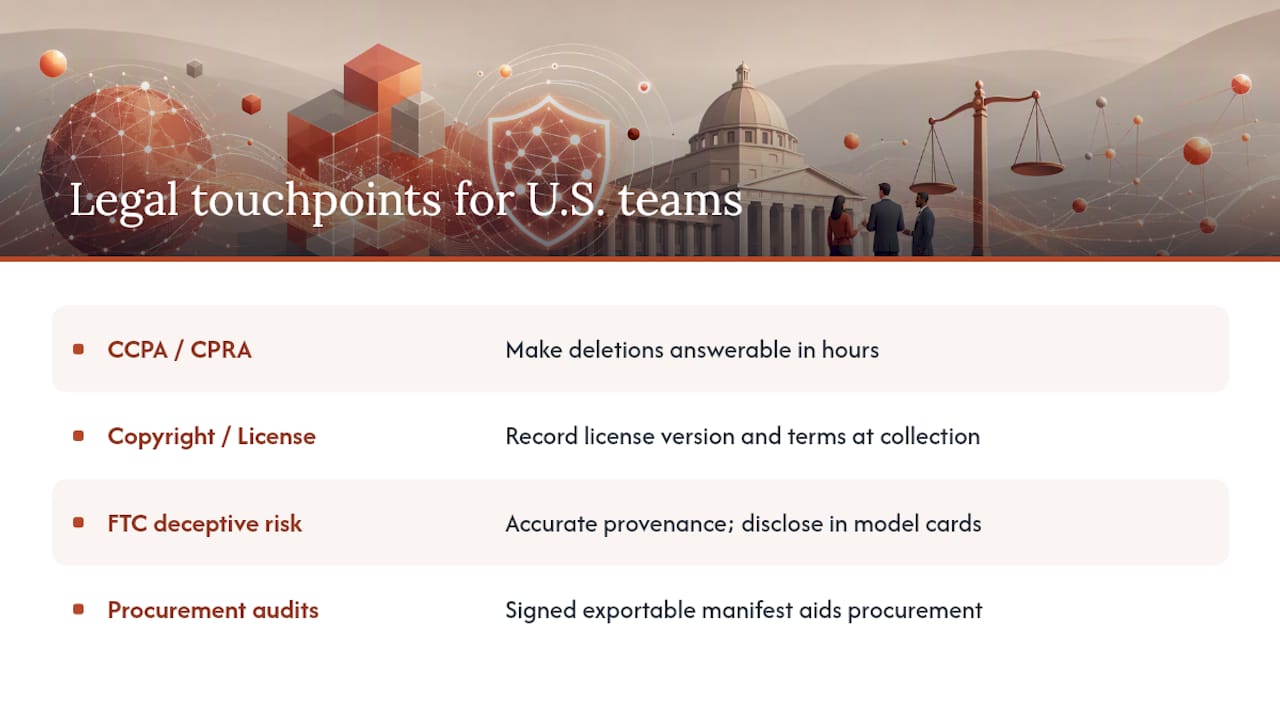
Procurement and enterprise audits. Federal contractors and large enterprise buyers increasingly require provenance evidence as a condition of AI system procurement. A team that can produce an exportable, signed manifest covering its training corpus has a material advantage in these processes.
Compliance checklist for provenance evidence
- Timestamps and source URLs for every record in the training corpus
- License version string and a copy or stable link to the license text
- Consent records (flag, basis, and date) for any personally identifiable content
- KYC status for contributors where applicable
- Transform history showing every processing step applied to the record
- A signed manifest hash recorded in the model card before training
Pro Tip: Design your provenance registry to store hash pointers and license strings rather than raw PII. When a record contains personal information, store the SHA-256 of the content and a pointer to the consent record rather than the content itself. This preserves verifiability while limiting privacy exposure in the provenance store.
Practical checklist: minimum viable provenance fields and how to operate them
Not every team can implement full token-level provenance on day one. The right approach is to start with minimum viable provenance and expand incrementally.
Minimum viable provenance fields (start here):
- Record UUID (stable, content-addressed)
- Source URL or file path
- Acquisition timestamp
- License or TOS version string
- Consent flag (boolean)
- SHA-256 fingerprint of raw content
Recommended full schema (add when capacity allows):
- Contributor KYC status
- Transform history (ordered list)
- Tokenizer name and version
- Token count
- Token-to-record index (for unlearning support)
- Merkle root or on-chain receipt hash
Storage and retention:
- Append-only object storage with versioning for the registry
- Cold storage tier for records outside the active training window
- Parquet for analytical queries, JSON-LD for semantic interoperability, CSV for audit submissions
- Retention period: model production lifetime plus applicable statute of limitations (consult counsel for your specific situation)
Operational roles:
- Collector app owner: responsible for assigning UUIDs and hashes at collection time
- Provenance registry owner: maintains the registry schema, access controls, and export pipelines
- Auditor: runs periodic queries to verify completeness and flag missing metadata
- Retention owner: enforces deletion schedules and responds to data subject requests
Pro Tip: Run a completeness check on your provenance registry before every training run. A simple query that counts records with null license fields or missing consent flags takes seconds and catches gaps that would otherwise surface only during an audit.
Common failure modes and how to mitigate them
The most common provenance failure is not a technical one. It is organizational: metadata is not captured at collection because the collection script was written before anyone thought about provenance, and by the time the gap is noticed, the original source URLs are stale or the content has changed. The fix is to treat provenance capture as a first-class requirement in any data collection spec, not a post-processing step.
Common failure modes:
- Missing metadata at collection. Provenance fields left blank because the collection script did not include them; no retroactive recovery is possible once the source changes.
- Fragmented provenance systems. Different teams maintain separate registries with incompatible schemas; no unified view exists across the full corpus.
- Synthetic or generated data with unknown origins. AI-generated content in training corpora often carries no provenance metadata; its license status is unclear and its consent basis is absent.
- Dataset-of-datasets composition loss. Repackaging strips original provenance; the aggregated dataset carries only the aggregator's metadata, not the original source records'.
- Index size and query latency at scale. Token-level indexes for billion-token corpora can reach sizes that make forget-set queries slow without careful partitioning.
Mitigation strategies:
- Enforce provenance capture at the collection layer with schema validation; reject records that fail required fields
- Adopt a single canonical registry schema (W3C PROV-compatible) across all teams and enforce it at the ingestion API
- Treat synthetic data as a distinct provenance category with its own consent and license fields; never inherit provenance from the model that generated it
- Re-verify provenance at each repackaging step; do not trust inherited metadata
- Use hybrid indexing (record-level index for most queries, token-level index only for unlearning workflows) to manage storage costs
The table below summarizes the key tradeoffs practitioners face when designing a provenance system:
| Design choice | Benefit | Cost / risk |
|---|---|---|
| Token-level granularity | Precise unlearning, attribution | High index storage, query complexity |
| Record-level granularity | Practical for most compliance needs | Cannot support token-attribution queries |
| Immediate per-record receipts | Real-time audit trail | Higher write latency, storage cost |
| Batched Merkle receipts | Lower cost, manageable overhead | Slight delay in anchoring |
| On-chain anchoring | Externally verifiable, tamper-evident | Cost per batch, dependency on chain availability |
| Internal registry only | Full control, no external dependency | Auditability depends on your own system integrity |
Key Takeaways
Effective AI data provenance requires record-level identifiers, cryptographic fingerprints, and license metadata captured at ingestion — before any transformation — to support unlearning, copyright defense, and CCPA compliance.
| Point | Details |
|---|---|
| Capture at ingestion | Assign a UUID and SHA-256 hash to every record before any transformation step runs. |
| Audit evidence is poor | Large-scale audits found license omission in ~68–70% of datasets and miscategorization around 50%, so inherited metadata cannot be trusted. |
| Record-level beats dataset-level | Record-level provenance enables targeted unlearning and per-record compliance queries; dataset-level documentation alone cannot support either. |
| U.S. compliance touchpoints | CCPA/CPRA deletion rights, FTC disclosure risk, and copyright litigation all require exportable, timestamped provenance records. |
| Aliakhtari for implementation | Aliakhtari provides custom provenance pipeline engineering, registry design, and audit-ready manifest generation for AI teams. |
A practitioner's view on realistic adoption paths
The gap between what provenance systems promise and what teams actually ship is mostly an organizational problem, not a technical one. The tooling exists: W3C PROV gives you a vocabulary, OriginBlame-style record tracking gives you a pattern, Traccia gives you an SDK, and Trace gives you an external registry. What most teams lack is the discipline to enforce provenance capture at the collection layer, before the data ever reaches the training pipeline.
The teams that get this right treat provenance as infrastructure, not compliance theater. They write the UUID assignment and hash computation into the collection script, not the preprocessing script. They run completeness checks before training runs, not after audits. And they design their registries to answer the questions a lawyer or regulator will actually ask: "Show me every record from this source, with its license, its consent status, and the date you collected it."
The realistic adoption path for most teams is incremental. Start with minimum viable provenance — UUID, source URL, timestamp, license string, SHA-256 — on new data collection. Run the MIT Data Provenance Explorer against your existing datasets to understand your current exposure. Add ingestion gates that reject records missing required fields. Then, when you have a stable record-level registry, extend to token-level indexing for the datasets where unlearning risk is highest.
The 1.3–4.0% throughput overhead reported for record-level provenance integration is not the obstacle. The obstacle is getting the first provenance-aware collection script deployed and the registry schema agreed upon across teams. That is where outside help pays for itself fastest.
Aliakhtari builds provenance-ready AI pipelines for teams that need audit trails
Most AI teams discover their provenance gaps during an audit or a legal challenge, not before. Aliakhtari works with startups and tech firms to build provenance infrastructure before that moment arrives: custom ingestion pipelines with record-level UUID assignment and SHA-256 fingerprinting, provenance registries designed for CCPA deletion queries and copyright audit exports, and Data Provenance Cards that meet the documentation standards auditors and enterprise buyers expect.

The work spans the full stack: collection scripts, ingestion hooks, registry schema design, OpenTelemetry-compatible telemetry integration, and exportable manifest generation. Engagements run as fixed-scope pilots (audit your existing corpus and design a remediation plan), full pipeline builds, or ongoing engineering support. If your team is assembling a training corpus now and has not yet addressed provenance, the right time to fix it is before the first training run. Review Aliakhtari's engineering work to see relevant prior projects, then reach out to scope a pilot.
Primary sources and further reading
The sources below underpin the claims and recommendations in this guide. Each entry notes what it contributes.
-
Data Provenance for AI — MIT Media Lab overview — The primary reference for the Data Provenance Explorer, Data Provenance Cards, and the 1,800+ dataset audit methodology. Start here if you want to audit third-party datasets before ingestion.
-
OriginBlame: Record- and Token-Level Data Provenance (arXiv) — The technical foundation for record- and token-level provenance patterns, measured integration overheads (1.3–4.0%), and the 42% unlearning efficacy improvement. Essential reading for engineers designing provenance-aware training pipelines.
-
Large-scale audits of AI text datasets — OpenReview — The source for the 68–70% license omission and ~50% miscategorization statistics. Grounds the urgency argument in empirical evidence.
-
Data Provenance in AI — Data Foundation analysis — Policy-oriented synthesis of provenance challenges and recommendations for industry and policymakers.
-
Data Authenticity, Consent, & Provenance for AI are all broken (arXiv) — Documents the fragmentation of the current ecosystem and the case for unified metadata standards.
-
Trace — Data Foundation public audit platform — Demonstrates receipt-based registration, Merkle batching, and per-record compliance posture computation. Useful for teams that need an externally verifiable audit trail.
-
Traccia — OpenTelemetry-based AI governance SDK (GitHub) — OpenTelemetry-compatible SDK for instrumenting LangChain and OpenAI agent pipelines with provenance telemetry.
-
AI Output Disclosures: Use, Provenance, Adverse Incidents — NTIA — U.S. policy framing connecting provenance to accountability, disclosure practice, and adverse-incident reporting.
-
Data provenance standards, documentation, and auditing (arXiv) — Academic survey covering Data Provenance Cards, schema recommendations, and the dataset-of-datasets composition problem.
This article provides general technical and policy information, not legal advice. Consult qualified legal counsel to confirm how specific regulations — including CCPA/CPRA, copyright law, and FTC guidance — apply to your organization's data practices.